Efficient Water Softening In Madison, WI
A Practical Guide To Managing Very Hard Local Water While Improving Efficiency And Protecting Your Home
Madison has very hard water, so a water softener is more than a convenience for many local homeowners. It can reduce scale, improve soap performance, and protect water heaters and other appliances from mineral buildup.
The amount of salt a softener uses matters, too. A system that is oversized, incorrectly programmed, or set to regenerate on a rigid schedule may consume far more salt and water than necessary. That raises operating costs and sends additional chloride into the wastewater system.
The good news is that you do not have to choose between protecting your home and using salt responsibly. A correctly sized and properly programmed water softener can do both.
Why Madison Has Such Hard Water
Madison receives its water from a deep underground aquifer. As water moves through mineral rich rock formations, it dissolves calcium and magnesium. These naturally occurring minerals are what make the water hard.
Madison Water Utility describes local tap water as very hard, generally containing about 18 to 20 grains of hardness per gallon. Hardness can vary by municipal well and neighborhood, with regional information showing a broader range of approximately 16 to 24 grains per gallon. Madison Water Utility
Water above 10 grains per gallon is considered very hard. At Madison’s levels, an untreated household can experience significant spotting, scale, and soap related problems.
Signs That Hard Water Is Affecting Your Home
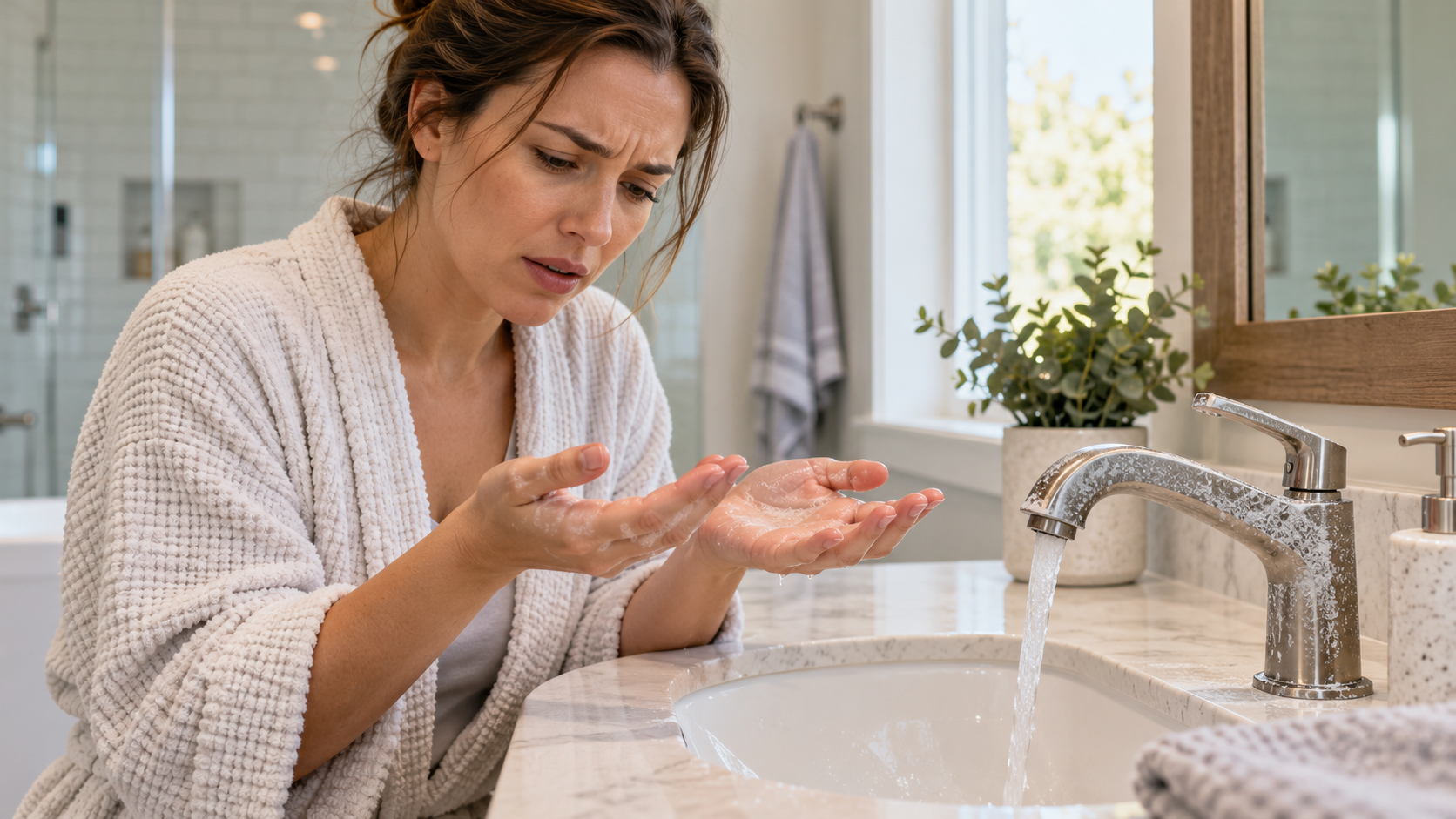
Hard water is usually clear and does not necessarily have an unpleasant taste. Most homeowners recognize it by the problems it creates after the water is used.
Common signs include:
- White residue around faucets
- Spots on glasses and dishes
- Cloudy shower doors
- Scale on showerheads
- Soap scum in tubs and showers
- Laundry that feels stiff
- Towels that become rough
- Dry feeling skin after bathing
- Reduced water flow through fixtures
- Mineral deposits inside water using appliances
These symptoms can become severe when water contains 18 grains of hardness or more.
Why Water Softener Salt Use Matters In Madison
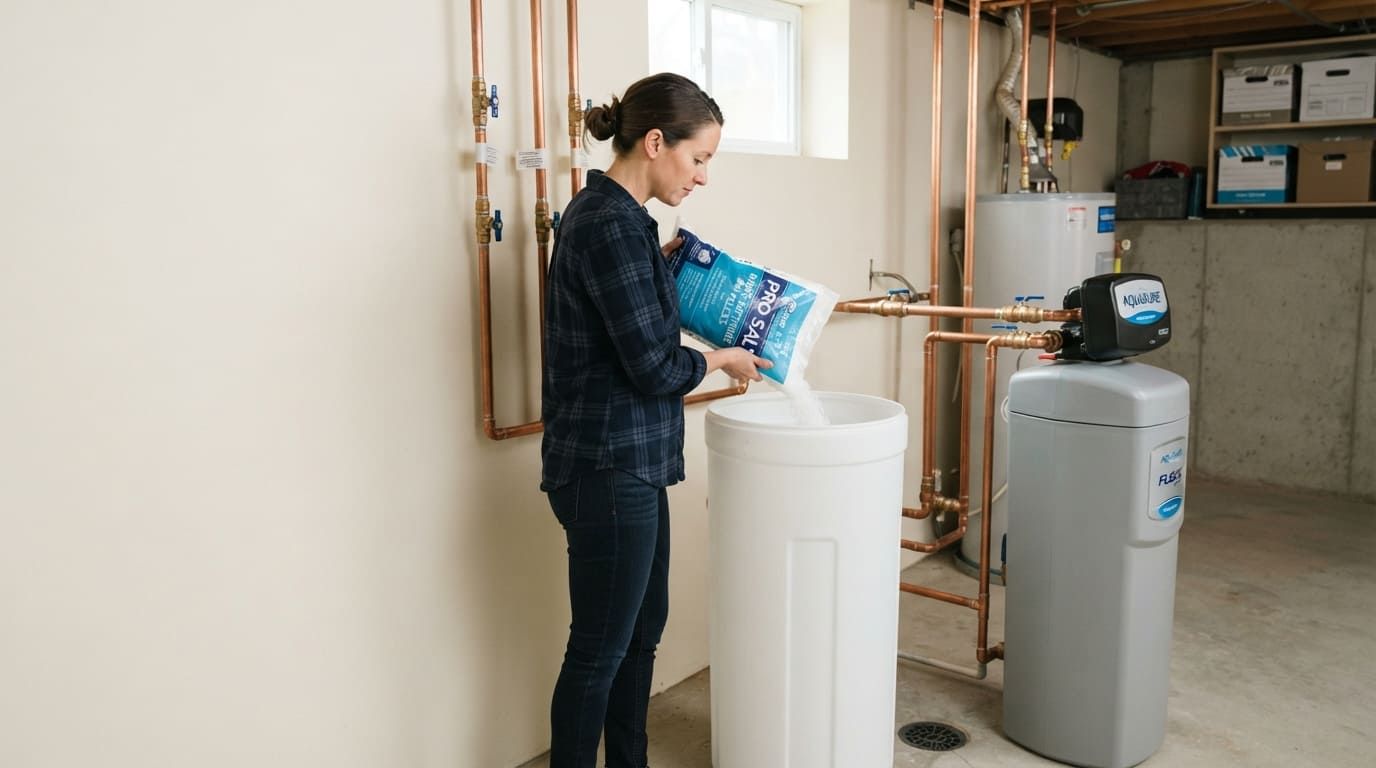
A traditional water softener captures calcium and magnesium using ion exchange resin. When that resin reaches its treatment capacity, the system regenerates using a concentrated salt solution.
The regeneration process sends the captured minerals and chloride down the drain. Wastewater treatment facilities are not designed to remove chloride easily, so reducing unnecessary salt use benefits both the homeowner and the local water system.
The goal is not to stop softening water that is causing problems. The goal is to make sure the softener uses only as much salt as necessary to provide the desired results.
Make Sure The Hardness Setting Is Correct
One of the most common causes of salt waste is an incorrect hardness setting.
Madison’s hardness level varies by location because different municipal wells serve different areas. Programming every softener to the same number can lead to poor performance or excessive salt consumption.
If the setting is lower than the actual hardness, the softener may run out of capacity and allow hard water into the home. If it is much higher than necessary, the system may regenerate too often.
The Madison Metropolitan Sewerage District provides a local hardness map that homeowners can use to find the expected hardness for their address. Madison Area Water Hardness Map
A professional evaluation can confirm the appropriate setting and test whether the system is producing soft water.
Use Demand Initiated Regeneration
Older water softeners commonly regenerate according to a timer. The system may run every few days whether the household has used its available capacity or not.
This is inefficient during vacations, periods of low water use, or in smaller households. It can also fail to keep up when water consumption increases.
A demand initiated regeneration system measures the amount of water used and regenerates when the resin is approaching its treatment capacity.
Benefits can include:
- Lower salt consumption
- Less water used for regeneration
- More consistent soft water
- Fewer unnecessary cycles
- Better response to changing household demand
- Reduced operating costs
The control valve still needs accurate hardness, capacity, and reserve settings to work correctly.
Choose A System Based On Your Household
A larger softener is not automatically more efficient. The correct size depends on how much hardness the system must remove and how much water the household uses.
Proper sizing should consider:
- Hardness at the property
- Number of household members
- Average daily water use
- Number of bathrooms
- Peak plumbing flow
- Iron content when applicable
- Desired time between regeneration cycles
An undersized system may regenerate constantly. An oversized unit may operate inefficiently or go too long between cycles. The best system provides enough capacity without requiring an excessive salt dose.
Check The Salt Dose Setting
Many softeners can be programmed to use different amounts of salt during regeneration. The highest salt setting may produce more capacity, but it is often less efficient in terms of hardness removed per pound of salt.
A moderate salt setting with properly calculated capacity can often provide better efficiency. The exact setting depends on the amount and type of resin, incoming hardness, water use, and system design.
This adjustment should be completed by someone who understands the control valve and can confirm the results with appropriate testing.
Consider A Blending Valve
Some homeowners prefer water that retains a small amount of hardness rather than water softened all the way to zero.
A blending valve mixes a controlled amount of untreated water with softened water. This lets the homeowner choose a level that balances comfort, scale reduction, and salt efficiency.
Leaving a few grains of hardness may reduce salt use while still providing a noticeable improvement over untreated Madison water.
A blending valve must be adjusted carefully. Too much untreated water can allow scale and spotting to return.
Decide Which Water Actually Needs Softening
It may not be necessary to soften every gallon used on the property.
Outdoor faucets used for watering lawns, washing vehicles, or filling a pool are often bypassed. Softening outdoor water can consume a large amount of salt without providing much benefit.
Some homeowners also choose to leave a separate cold water line untreated for drinking and cooking. Madison Water Utility recommends considering an unsoftened supply for these uses.
A thoughtful plumbing layout can reduce treatment demand while preserving softened water where it provides the greatest benefit.
Watch For Salt Bridges
A softener may appear to have plenty of salt but still fail to regenerate correctly. This can happen when a hardened crust forms inside the brine tank, creating an empty space underneath.
Known as a salt bridge, this condition prevents salt from dissolving into the water needed for regeneration.
Possible signs include:
- The salt level never seems to change
- Hard water symptoms suddenly return
- The system regenerates without producing soft water
- The brine tank looks full for an unusually long time
Inspecting the tank periodically can help catch the problem before mineral buildup returns throughout the home.
Repair Leaks That Increase Softener Use
A leaking toilet, dripping faucet, or malfunctioning appliance can send hundreds of extra gallons through a water softener.
Demand based equipment interprets this flow as normal household use. The additional water consumes capacity and causes more frequent regeneration.
If salt consumption suddenly increases, check for:
- Running toilets
- Dripping faucets
- Leaking outdoor spigots
- Malfunctioning humidifiers
- Refrigerator water line leaks
- Continuous flow to a floor drain
Correcting the leak can reduce both water and salt use.
Replace Inefficient Older Equipment
A well maintained softener can provide many years of service, but older equipment may use more salt and water than a modern demand based system.
Replacement may be appropriate if the existing unit:
- Regenerates on a fixed timer
- Uses excessive amounts of salt
- No longer produces consistently soft water
- Has a leaking control valve
- Creates a noticeable pressure drop
- Requires frequent repairs
- Cannot be programmed accurately
A service evaluation can determine whether adjustment, repair, resin replacement, or a new system makes the most sense.
Water Softening And Filtration Are Different
A water softener removes calcium and magnesium. It does not serve as a complete drinking water filtration system.
If your concern is chlorine taste, odor, sediment, or another specific substance, a separate filter may be appropriate.
Available options can include:
- Whole house carbon filtration
- Sediment filtration
- Reverse osmosis drinking water systems
- Specialty filters selected from test results
Each system should be chosen for a clearly identified purpose.
Get Efficient Water Softening For Your Madison Home
Madison’s very hard groundwater makes correct water softener sizing and programming especially important. The right system can reduce scale and protect your home without using more salt and water than necessary.
Madison Water Softener provides water testing, water softener installation, system programming, whole house filtration, reverse osmosis systems, and iron filtration in Madison, Wisconsin.
Contact Madison Water Softener to have your current equipment evaluated or receive a properly sized recommendation for your home.